
If your kitchen feels chaotic, you’re probably missing one simple thing: a clear system. Learning how to organise kitchen cupboards turns daily cooking from a scramble into a smooth routine. You open a door, you grab what you need, and you move on. That’s the calm power of how to organise kitchen cupboards.
Messy cupboards waste time and money. When you can’t see what you have, you buy duplicates and forget food at the back. With how to organise kitchen cupboards, you build a home for everything, so nothing gets lost. Even five minutes of order can save you a shopping trip.
This guide keeps it practical for UK and US kitchens. You’ll use simple steps, zones, and easy storage tweaks that fit real life. By the end, you’ll know how to organise kitchen cupboards in a way that stays neat, feels natural, and makes your kitchen quieter each day.
Why Kitchen Cupboard Organisation Matters More Than You Think
When you improve kitchen cupboard organisation, you don’t just make shelves look nicer. You make your day easier. A cluttered cupboard slows you down because you keep searching, moving, and re-stacking. However, a clear setup gives you one-touch living. You pick something up, you use it, then you put it back in its place.
Here’s a simple truth that fits both UK and US homes: space stays the same, yet systems change everything. The right kitchen organisation ideas make your cupboards feel calm, even on busy weekdays. When you follow sensible kitchen storage ideas, you create tidy kitchen cupboards that stay that way after real meals and real mornings. If you organise kitchen cabinets with clear zones, your kitchen starts to feel bigger. You also waste less food because you stop losing items at the back.
Quote: A calm kitchen isn’t a luxury; it’s a routine you design. That routine matters because kitchens are high-traffic spaces. When you practise how to organise kitchen cupboards, you remove daily friction without even noticing it.
What You’ll Need Before You Start Organising Kitchen Cabinets
Start simple. A cloth, a bin bag, and three boxes will do. Those boxes support kitchen cupboard sorting because they force quick decisions. Label them keep, move, and bin. Then add a marker for labelled kitchen storage later.
If you want extra help, choose only what matches your pain points. For spills and half-open packets, use kitchen storage containers. For awkward piles, use kitchen cupboard organisers or kitchen cabinet organisers. For deep shelves, pick sturdy bins that slide. Keep it practical, not pretty-for-a-photo.
Think of your set-up like building a wardrobe. You wouldn’t hang socks next to coats. In the same way, good kitchen cabinet organisation starts by keeping like with like, then placing items where you actually use them.
How to Declutter Kitchen Cupboards Without Feeling Overwhelmed
To declutter kitchen cupboards without melting down, work one cupboard at a time. Set a timer for 20 minutes. Stop when the timer ends. This keeps the job light and repeatable. You can always do another round tomorrow.
Use a quick decision rule. If you haven’t used an item in a year and it isn’t a special occasion piece, move it out. If it’s expired, bin it. If you own three of the same thing, keep the best one and donate the rest. This is how to declutter kitchen cupboards in a way that feels clean, not cruel.
A small case study shows the payoff. A couple in Manchester tracked their spending for one month. After a cupboard reset, they stopped buying duplicate spices and sauces. They estimated they saved £25 that month just by seeing what they already had. That’s not magic. It’s visibility.
A simple keep test you can copy
Use this short paragraph-form list as you sort. Keep it if you use it weekly. Keep it if it supports your everyday meals. Keep it if it replaces takeaway at least once a week. Otherwise, move it to a back-up spot or let it go.
How to Organise Kitchen Cupboards Step by Step for a Tidy Kitchen
If you want how to organise kitchen cupboards step by step, treat it like building a small shop. You want clear sections, front-facing choices, and easy restocking. Start by emptying one cupboard. Wipe the shelf. Then take a quick photo. That photo helps you remember what before looked like, which keeps motivation high.
Next, plan your kitchen cupboard layout. Put daily items at eye level. Put heavy items low. Put rarely used items high. This simple structure is the foundation of how to organise kitchen cupboards efficiently because it matches how your body moves.
Now create kitchen cupboard categories. If you like a clear method, use how to organise kitchen cupboards by category as your rule of thumb, then keep each category in one home. Build kitchen cabinet zones that fit your routine. If you make tea ten times a day, give tea its own zone near the kettle. If you bake once a month, baking can live higher up.
After that, decide your kitchen cupboard arrangement. Place what you grab first at the front. Place back-up items behind. Use labelled kitchen storage for bins and containers so anyone in the home can follow the system without guessing.
Finally, do a five-minute shake test. Open and close doors. Pull out pans. Reach for your most-used mug. If something feels annoying, adjust it now. This is how to organise kitchen cupboards neatly in a real, lived-in way.
How to Organise Kitchen Cupboards Using Smart Storage Ideas
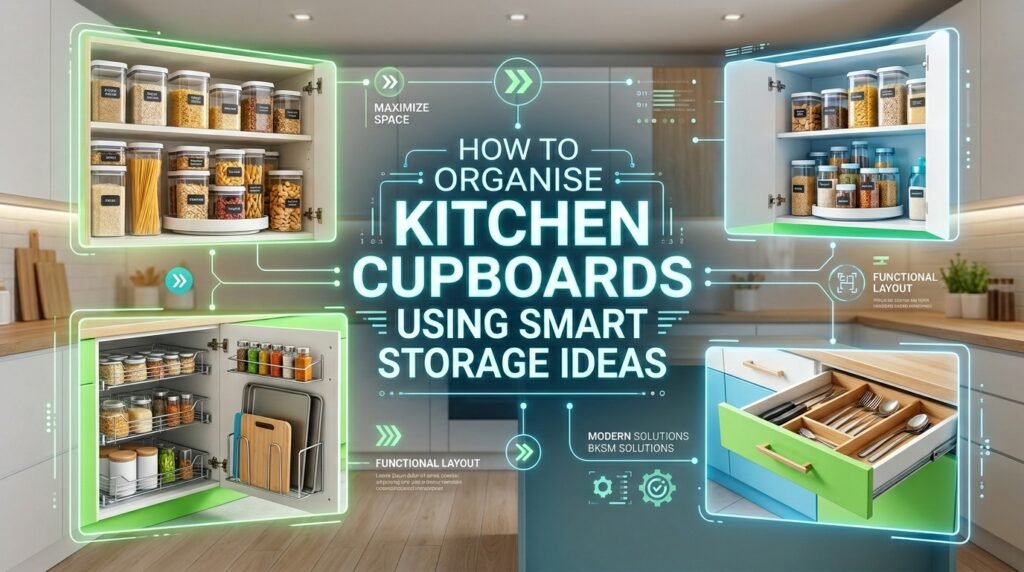
Good kitchen cupboard storage ideas rely on three goals: reduce piles, boost visibility, and stop dead space. Start with containers for loose items. When you use kitchen storage containers, you turn ten messy packets into one tidy block. It’s cleaner and it’s faster to grab.
Next, use shelves wisely. If you stack plates too high, they wobble. If you keep mugs in a deep corner, they vanish. A simple riser can double a shelf, which supports maximise cupboard space without renovations. For UK kitchens with shallower cupboards, a slim riser often works better than a bulky organiser.
Now look at the back of deep cupboards. This is where deep cupboard storage ideas matter. Use a pull-out bin for tins or packets, then you can lift the whole section forward. That’s one of the most useful kitchen cupboard storage solutions because it prevents the lost-at-the-back problem.
You can also borrow a trick from professional kitchens: keep duplicates together. Store spare pasta, rice, and tins in one backstock bin. This simple move supports pantry and cupboard organisation because it stops you spreading the same item across three cupboards.
How to Organise Kitchen Cupboards to Save Space and Reduce Clutter
If your kitchen feels small, you don’t always need more cupboards. You need better flow. Space saving kitchen storage starts with removing air gaps. Air gaps happen when you store half-empty bags, odd-shaped stacks, and random just-in-case gadgets.
Begin with your most awkward areas. Corner cupboard organisation works best when you store bulky, low-use items there, like slow cookers or large serving bowls. If you place daily items in corners, you’ll keep reaching into the dark and knocking things over.
Then tackle vertical space. Store chopping boards upright. Store trays on their side. Nest pans by size. These are kitchen cabinet organisation hacks that free space instantly. For narrow cupboards, use bins that you can lift out like drawers. Those are kitchen cupboard organisation hacks because they turn chaos into one smooth pull.
If you’re working with a flat or a tight galley layout, focus on small kitchen storage solutions. Keep only one of each tool you truly use. Use slim containers. Group snacks in one basket. These moves show how to organise kitchen cupboards in a small kitchen without buying a new kitchen.
A short case study from a US apartment kitchen makes this clear. A renter in Boston used two bins and a label maker. One bin held breakfast. One bin held snacks. She said her counters stayed clearer because cupboards stopped overflowing. That is how to organise kitchen cupboards for more space in action.
How to Organise Kitchen Cupboards for Easy Cooking and Daily Use
Your cupboards should support your routine, not fight it. The easiest method is to organise by workflow. Keep oils, salt, pepper, and your top spices together. Keep pans near the hob. Keep chopping boards near prep space. This is how to organise kitchen cupboards for cooking in a way that saves minutes every meal.
If you meal prep, build a simple prep zone. Store containers, lids, cling film, and foil together. Then add a small section for grab-and-go items. This is how to organise kitchen cupboards for meal prep without turning your kitchen into a warehouse.
A useful comparison is a toolbox. You don’t scatter screwdrivers around the house. You keep them together because you use them together. Do the same with kitchen tools. When you follow this, you learn how to arrange items in kitchen cupboards so your hands move on autopilot.
To keep it practical for mixed households, make a shared everyday shelf. Put mugs, plates, and the most-used glasses there. Put special items higher. This supports how to organise kitchen cupboards for everyday use because it reduces clutter at eye level.
How to Organise Kitchen Cupboards with Simple and Practical Tips
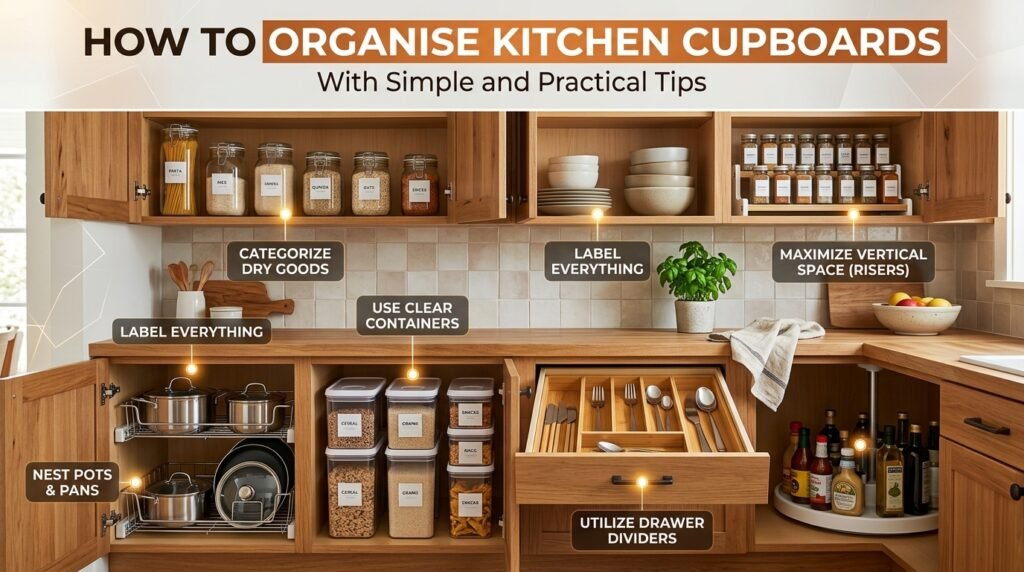
If you want the best way to organise kitchen cupboards, keep the system boring and repeatable. Fancy systems fail when real life hits. Start with one cupboard. Finish it. Then move on. That’s the easy way to organise kitchen cupboards when you’re busy.
If you need speed, use a quick reset method. Put similar items together. Put daily items forward. Put extras behind. Label one or two bins. This is how to organise kitchen cupboards fast without making a bigger mess.
For money, use what you already own. Reuse jars. Reuse boxes. Use tape labels. This is how to organise kitchen cupboards on a budget while still getting a clean look. For renters, stick to removable tools. Use bins, risers, and baskets. This is how to organise kitchen cupboards for renters because you can take it with you.
For households with kids, keep snacks low and safe. Keep sharp tools high. Give children one snack bin so they can choose without rummaging. This is how to organise kitchen cupboards for families and it also supports how to organise kitchen cupboards for less mess because hands stop digging through everything.
However, tips only work if you keep them alive. A two-minute reset after dinner is the habit that protects the whole system. This supports how to organise kitchen cupboards and stay organised without effort.
How to Organise Kitchen Cupboards to Keep Everything Easy to Find
Finding things fast is about consistency. If you store cereal in three places, you’ll always feel confused. Pick one home for each item. Then protect that home with labels, bins, or simple routines. This is how to keep kitchen cupboards organised when life gets busy.
If you like a clean look, try how to organise kitchen cupboards with containers for dry goods. Clear containers help you spot low stock. They also prevent spills. If you like flexible storage, use how to organise kitchen cupboards with baskets for snacks, tea bags, and small packets.
Labels make a big difference for shared kitchens. Use how to organise kitchen cupboards with labels to keep zones obvious. Label the front of bins. Label shelves if needed. This strengthens kitchen cupboard storage solutions because the system becomes self-explaining.
You can still succeed without buying anything. If you’re keeping costs tight, use how to organise kitchen cupboards without organisers by grouping items and using spare boxes as dividers. The key is to keep each group stable. That’s what makes your cupboards feel easy.
Under Sink Cupboard Organisation Without the Leaks and Chaos
The sink cupboard is tricky because pipes steal space. Damp can also ruin cardboard and paper. Good under sink cupboard organisation starts with containment. Put cleaning sprays in one waterproof bin. Put cloths and sponges in another. Keep bin bags together. Then place a washable mat under everything so drips don’t become a disaster.
Keep this area simple because it’s easy to overfill. If you store too much, you’ll hate opening the door. Choose only what you use weekly. Store back-ups elsewhere. This also supports space saving kitchen storage because you stop using the sink area as a dumping ground.
Kitchen Cupboard Makeover Checklist for Long-Term Results
A real kitchen cupboard makeover doesn’t end when you close the door. It lasts when you build small habits. Do a weekly scan before your main shop. Pull older items forward. Put new items behind. This keeps food visible, then it reduces waste.
If you share a home, make the rules obvious. Keep one backstock bin for duplicates. Keep one incoming spot for new groceries until they’re put away. These small moves protect pantry and cupboard organisation and stop clutter creeping back.
| Goal | What you do | Why it works |
| Keep order | Reset for two minutes nightly | Mess stays small |
| Reduce waste | Rotate older items forward | You use what you have |
| Protect space | Limit duplicates to one bin | Cupboards don’t overflow |
| Clean easier | Wipe shelves monthly | Crumbs don’t build up |
When you keep this routine, you support how to organise kitchen cupboards for easy cleaning and you also protect how to organise kitchen cupboards for maximum storage because space stays usable.
Quick-Reference Layout Examples
A simple layout works in most kitchens. Put daily items at eye level. Put heavy items low. Put rarely used items high. Keep extras in one backstock area. Keep snacks together. Keep baking together. Keep cooking basics together. This is kitchen shelf organisation that feels natural.
| Zone | Best shelf | Example items |
| Everyday drinks | Eye level | mugs, tea, coffee |
| Everyday cooking | Eye level | oils, spices, pasta |
| Heavy tools | Low | pans, appliances |
| Rare use | High | platters, seasonal items |
This simple system ties together kitchen cupboard storage ideas, kitchen cabinet storage ideas, and day-to-day ease. If you ever feel stuck again, return to how to organise kitchen cupboards and rebuild one zone at a time.
FAQs
How do I start when my cupboards are a total mess?
Empty one cupboard first. Then follow how to organise kitchen cupboards by sorting into keep, move, and bin groups.
What’s the quickest way to make cupboards feel tidy?
Group items by use. This is how to organise kitchen cupboards fast and keep daily items easy to grab.
How can I stop buying doubles of the same thing?
Keep similar items together and label them. How to organise kitchen cupboards helps you see stock instantly.
What should I do with awkward deep cupboards?
Use pull-out bins or baskets. How to organise kitchen cupboards works best when you bring items forward.
How do I organise cupboards in a small kitchen?
Use zones and stack smartly. How to organise kitchen cupboards saves space by keeping only what you use.
How do I keep the cupboards organised long-term?
Do a two-minute reset daily. How to organise kitchen cupboards stays easy when everything has one home.
Do I need organisers to make this work?
No, boxes and labels work too. How to organise kitchen cupboards succeeds with simple, consistent grouping.
Conclusion
You don’t need a showroom kitchen to feel calm. Start with one cupboard, then repeat the same simple pattern. Each time you practise how to organise kitchen cupboards, your kitchen gets easier to live in. You’ll cook faster and you’ll waste less.
Keep your system light. Use zones, clear homes, and quick resets. When you stick to how to organise kitchen cupboards, you stop stuffing things anywhere for now. Instead, you put items back where they belong, even on busy nights. That’s how order stays. If things slip, don’t panic. Do a 10-minute refresh quickly. Return to how to organise kitchen cupboards and reset one zone. With how to organise kitchen cupboards, progress beats perfection every time. You’ll open a door and smile. Trust how to organise kitchen cupboards. Everything sits where it should, and your kitchen feels stress-free again.
How to paint kitchen cupboards like a pro: simple prep, paint and curing steps that save money and leave a smooth, tough finish.